Introduction
An autopilot keeps a ship on a set course without a helmsman at the wheel. It is used when a ship has to steer one course for a long time. Any deviation is controlled electronically and automatically, so the officer of the watch can concentrate on lookout and navigation. This article explains how the autopilot works, how its control unit combines proportional, derivative and integral control, what each control on the panel does, and when an autopilot should not be used.
How the Autopilot Works
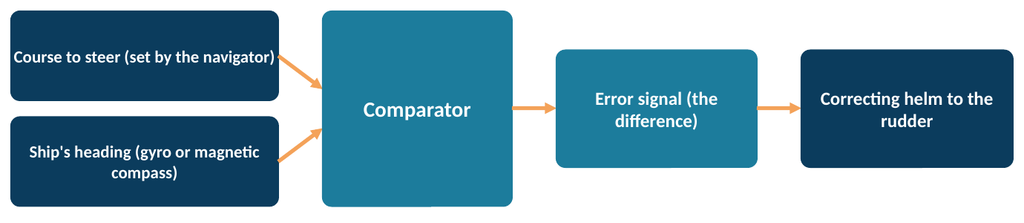
The autopilot compares the course set by the navigator with the ship’s heading from the gyro or magnetic compass. Any difference between the two is an error, and correcting helm is applied to the rudder until the heading equals the set course. As soon as the ship deviates, the requisite helm is applied at once to bring her back.
Using an autopilot over a long period has clear benefits:
- Less work for the helmsman: deviation from the course is controlled electronically and automatically.
- Higher average speed: the ship does not zig zag across the track.
- Less wear and lower fuel use: the steering gear operates to a minimum, and a good automatic steering system also reduces fuel consumption.
A ship’s manoeuvring characteristics depend on her type, length and beam, and they change with trim, loading and weather. Certain critical controls therefore have to be set optimally to get efficient automatic steering. The system must also have indicators showing whether steering is on manual or autopilot, and the changeover switch must be on or near the steering panel.
Simplified Block Diagram
The course to be steered is chosen with the course selector knob, while the present heading comes from the gyro or magnetic compass. The compass output goes to the comparator in the control unit, together with the manually set course. Any difference between the two produces an error signal whose size is proportional to the difference, so the comparator is also called the proportional control.
The control unit also contains integral and derivative controls. They analyse the signals from the compass and the course selector, and a summing amplifier combines the three into a resultant error signal.
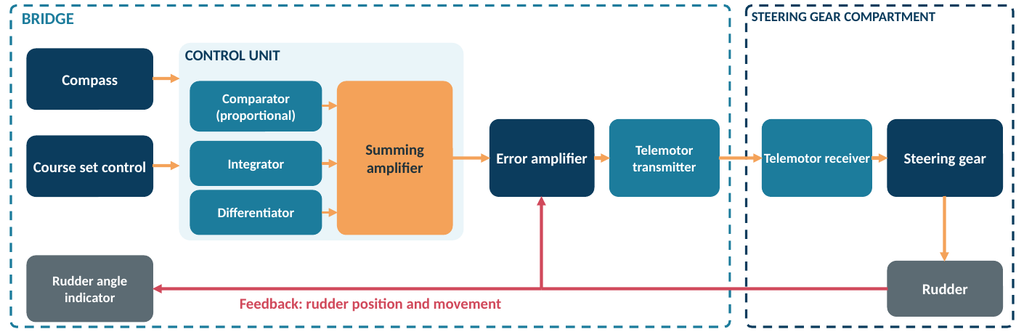
The error signal goes to the error amplifier, which also receives feedback from the rudder: its position and its movement. The output goes through telemotors to the steering gear, which moves the rudder. The telemotor has two units, a transmitter on the bridge and a receiver in the steering gear compartment.
When the difference between the two signals is zero, the control unit gives no output, and the rudder does not move.
The Control Unit: Proportional, Derivative and Integral
To hold the course as accurately as possible, the helm needs data about the ship’s movement relative to the course-to-steer line. Electronic circuits provide it through three controls, which form the heart of the control unit.
Proportional Control
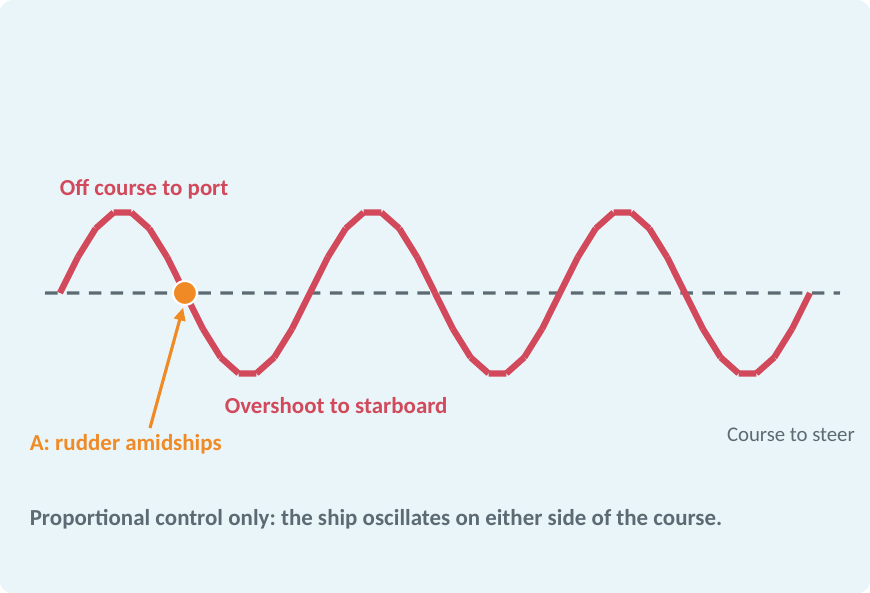
With proportional control alone, the rudder moves by an amount proportional to the ship’s error from the course to steer, and the ship oscillates on either side of the required line. If she has gone off course to port, starboard helm is used to bring her back. The helm is gradually reduced as she returns, and it is removed when she is back on course.
As the ship approaches the course at point A, the rudder is amidships, so she overshoots to starboard. Correcting data then gives a port turn to bring her back to the course line.
Derivative Control
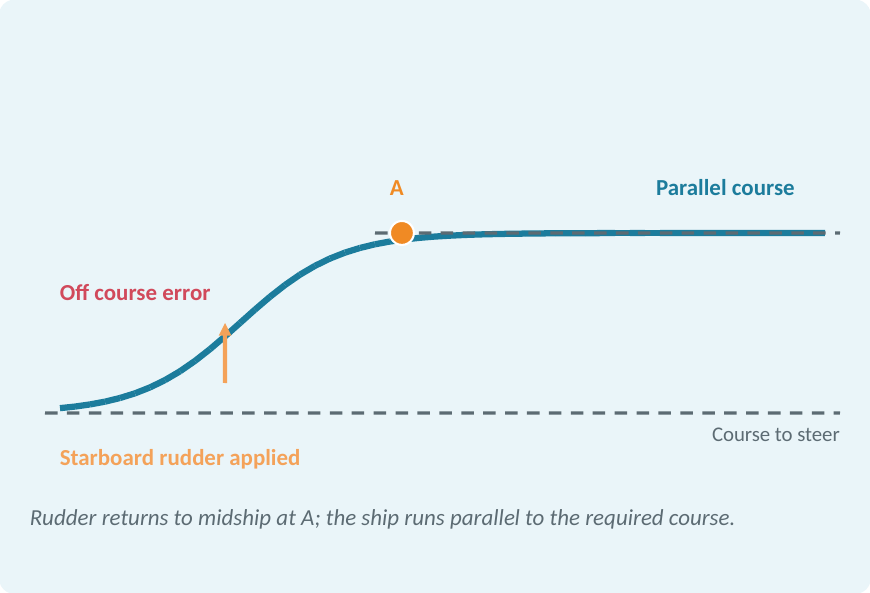
In derivative control, the rudder is shifted by an amount proportional to the rate of change of the ship’s deviation from the course. A deviation to port causes starboard rudder to be applied. As the rate of change of course falls, the rudder control reduces too, and at point A the rudder returns to midship. The ship then makes good a course parallel to the required one.
Proportional and Derivative Together
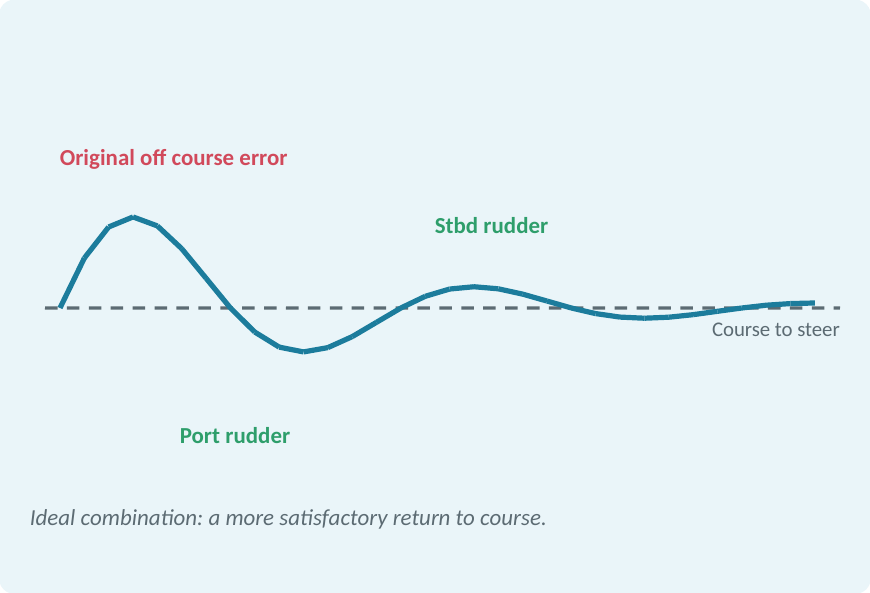
An ideal combination of the two gives a more satisfactory return to the course than either alone: the ship comes back to the line with smaller swings.
Integral Control
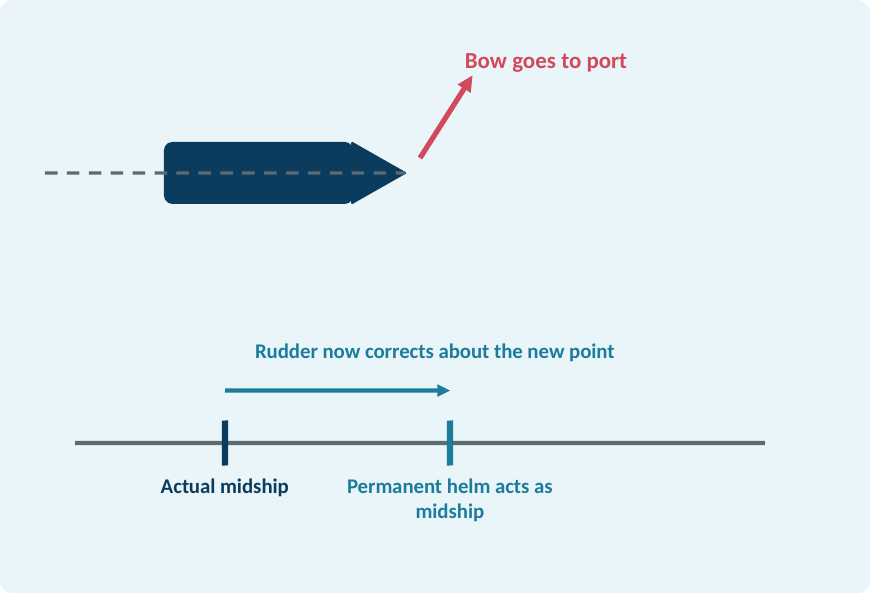
Some errors come from the ship’s design, such as the shape of the hull, or the bow going to port when she makes headway because of transverse thrust. These also have to be corrected. The system senses the heading error continuously over a period and applies a suitable amount of permanent helm. The rudder then corrects the course about this permanent helm instead of the true midship position, so the permanent helm acts as midship.
The outputs of the three controls are combined, and the net result drives the rudder to keep the ship on the set course. This is why the system is called a PID autopilot.
Controls on the Autopilot Panel
The settings of the critical controls are governed by the ship’s manoeuvring characteristics in her present displacement and trim, and by the prevailing weather.
- Course selector knob: the primary control of the system. The course to be steered is selected with it.
- Rudder control: decides how much rudder is used to correct even the slightest deviation. A high setting gives larger rudder angles, which may over-correct. A low setting gives less rudder and a slow return to course. Set it to an optimum.
- Counter rudder: decides how much counter action the rudder applies to steady the ship and keep overshoot to a minimum. Too low and the ship overshoots; too high and she returns slowly. Rudder and counter rudder work together, so set rudder first and then counter rudder.
- Yaw: depends on the wind and weather. Use a higher value in strong wind and rough sea, and a low value in calm weather.
- Permanent helm: holds a steady rudder angle against cross winds that push the ship off course. Use just enough to offset the drift.
- Speed: the speed decides how effective the rudder is. At lower speed the rudder is less effective, and vice versa. It is normally fed from the log; enter it manually if the log is not working.
- Rudder limit: the maximum rudder angle used when correcting heading or altering course on autopilot. For example, set 10° if the alteration is to be made with 10° helm. If she overshoots, the opposite corrective helm is also limited to 10°. Vary it to suit the navigator.
- Off course alarm: sounds when the ship deviates from the set course by a pre-decided limit. Use a wider limit in rough seas and strong winds, and a narrower one in calm weather. It also warns you if the autopilot fails.
- Synchronization control: temporarily disconnects the gyro repeater from the main gyro so it can be synchronized with the master gyro. It is normally not needed, except when the gyro is switched off and restarted, or the repeater has drifted.
- Auto / Follow up / Non follow up: chooses between automatic and manual steering. Non follow up steering may be chosen if manual steering fails.
- Dimmer: adjusts panel illumination. Set it so the panel and controls are clearly visible at night without affecting the officer of the watch’s night vision.
Large Alterations of Course: Constant Rate of Turn
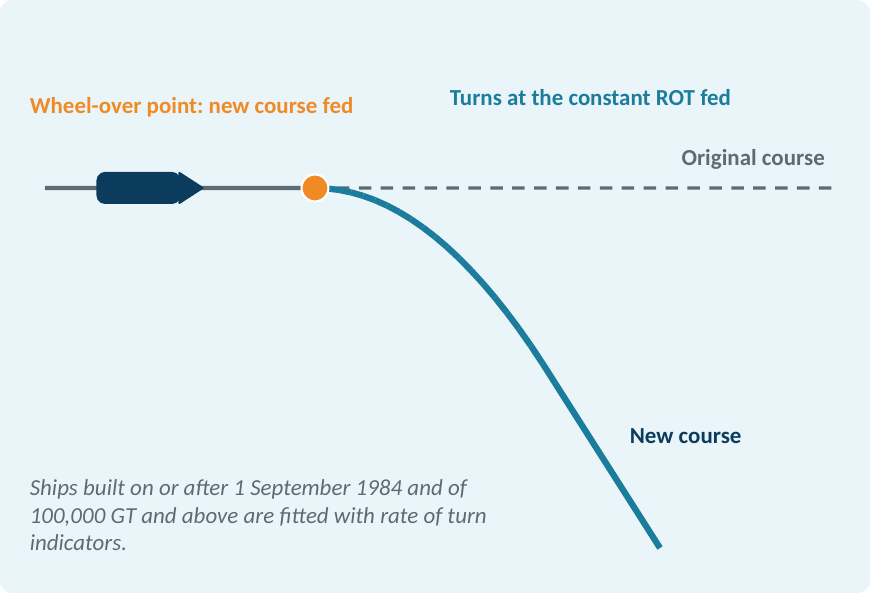
Ships built on or after 1 September 1984 and of 100,000 gross tonnage and above are required to carry rate of turn indicators. On these ships, a large alteration of course can be made on the autopilot itself using the constant rate of turn technique. The panel has controls for this, and the constant rate of turn to be used is fed into the autopilot with them.
When the ship reaches the wheel over point on the original course, the new course is fed to the autopilot. The ship then makes the turn and steadies on the new course at the constant rate of turn that was fed in. The rudder limit must allow this. If the value fed in is so low that the desired rate of turn cannot be achieved, increase the rudder limit.
Precautions
- Changing over: IMO’s performance standard allows changeover between automatic and manual steering at any rudder angle. It is good practice to change over with the rudder midship, except in an emergency.
- Regular checks: check that the gyro repeater is synchronized with the master repeater, that the control settings are optimum and adjusted if required, that the off course alarm works, and that hand and emergency steering have been tried out.
- Close quarter situation: if one is developing, do not leave the ship on autopilot. Steer manually until the situation is overcome.
- Maintenance: carry it out as specified in the manual.
When Not to Use the Autopilot
An autopilot is a course keeper, not a helmsman. Do not use it:
- In a narrow channel
- At slow speeds
- During manoeuvring or in pilotage waters
- In areas of heavy traffic
- During heavy weather conditions
- While carrying out large alterations of course (except with the constant rate of turn technique above)
- In areas of poor visibility
Conclusion
The autopilot compares the set course with the heading and applies correcting helm. Its control unit combines proportional, derivative and integral control, which is why it is called a PID autopilot. Set its controls to suit the ship’s displacement, trim and the weather, and check the gyro repeater and off course alarm regularly. Above all, remember that it is a course keeper, not a helmsman: take over manually in narrow channels, pilotage waters, heavy traffic, heavy weather and poor visibility.
Also read
Ship Stopping Distance: Head Reach and Track Reach Explained
Leave a Reply